Passover and the First Holy Day Season
©2024 Plan-of-God.com
The Passover and the First Holy Day season encompasses God’s plan of salvation – from beginning to end – God is the starter of humanity’s calling, and He will finish it.
Please feel free to print this off and share it anywhere, with anyone and everyone. There is a Download button at the bottom of the page.
The Passover event pictures Christ paying the penalty for all sin through the shedding of His blood. The Passover occurs before the holy days, it had to come first, God planned it this way. Without Christ’s blood being shed there can be no redemption, no removal of sin from us, no cleansing. In effect, all of God’s plan for mankind would become impossible, a waste of time without Christ’s sacrifice. For an explanation see The Passover Must Come First.
In this bible study we will look a bit more into the Passover and its relationship to the holy days, and also consider Christ’s resurrection. While the New Testament Passover commemorates the covering of sin, it is Christ’s resurrection that paves the way for us to receive eternal life as spirit beings. Mainstream Christianity puts a lot in store by celebrating Christ’s resurrection on the morning of Easter Sunday, but is that correct? What does God’s word say, was Christ resurrected in the morning, and what else happened on that morning?
Let’s take a look at the timeline
Before we can understand the timeline, we need to remind ourselves of the differences between the way God said to measure days, months and seasons to how these are measured according to the Gregorian calendar that is used around the world. The Gregorian calendar is a solar calendar, i.e. it is solely based on the rotation of the earth around the Sun, one rotation equals one year, with each year being just under 365¼ days, with every fourth year having an extra day (February 29th).
In contrast God set out a calendar based on both the Moon and the Sun.
Genesis 1V14 And God said, Let there be lights in the firmament of the heaven to divide the day from the night; and let them be for signs, and for seasons, and for days, and years:
V15 And let them be for lights in the firmament of the heaven to give light upon the earth: and it was so.
V16 And God made two great lights; the greater light to rule the day, and the lesser light to rule the night: he made the stars also.
V19 And the evening and the morning were the fourth day.
The very first thing that God did was to define a day, the 24 hour period, before we are even told about the sun and the moon.
Genesis 1V5 And God called the light Day, and the darkness he called Night. And the evening and the morning were the first day.
God defined that a day starts with darkness, with day – the light, coming after the darkness, “And the evening and the morning were the first day”. Satan has perverted God’s truth and now virtually the whole world starts and ends a day in darkness, at midnight. But God is the Light of the World, so darkness is banished with light.

God’s calendar is based on the Sun and the Moon
In brief, God’s calendar months have either 29 or 30 days, and some years have 12 months, and some have 13 months. Over the course of 19 years the Gregorian Solar calendar comes into alignment with God’s sacred calendar. The details of God’s calendar can be complex, with many people using formulae to determine the start of a year and the various seasons, while others determine it by the growth of barley near Jerusalem and watching for a sign of a new moon. We won’t go into that in this study, but a good overview can be found at here and the formulae for calculating the calendar here. Nevertheless, God’s calendar has a special purpose, it signals seasons and days representing aspects of His plan for mankind, for His plan of salvation.
There is evidence that at least part of God’s calendar was known from the time of Adam and Eve.
Genesis 4V3 And in process of time it came to pass, that Cain brought of the fruit of the ground an offering unto the LORD.
V4 And Abel, he also brought of the firstlings of his flock and of the fat thereof. And the LORD had respect unto Abel and to his offering:
It is interesting that in verse 3 in the King James version that the Hebrew word translated “process” is usually translated “end”, and the Hebrew word translated “time” is over 30 times more likely to be translated “day”. Is this an indication that at the end of a specific day Cain and Abel made their sacrifice to God? It also suggests that Cain and Able were used to making sacrifices to God, and that they had a calendar, which God gave them, to know when to make a sacrifice. Perhaps the use of a calendar could also be inferred from the translation “in the process of time”. However, it is clear that both Cain and Able, and presumably also their parents and siblings, made sacrifices to God as He commanded them. But over time, to the time of Noah and beyond, the vast majority humanity forgot God, and God only worked with a select few. God allowed humanity to go their own way.
God reintroduced His calendar to Israel at the time of their exodus from Egypt. After the death of Joseph and their progressive move to slavery, Israel had lost knowledge of God’s calendar, including the sabbath day, and knowledge of when to make sacrifices to God.
Let’s take a look at the Old Testament instruction given to Moses.
Exodus 12V1 And the LORD spake unto Moses and Aaron in the land of Egypt, saying,
V2 This month shall be unto you the beginning of months: it shall be the first month of the year to you.
Here God instructs Moses when the year should begin. This scripture does not tell Moses how to determine the first day of the month and year, Moses already knew that; the first day of the first month would occur when the new moon just became visible, so God just told Moses which new moon heralded the first month. Later, during the exodus, God reintroduced the sabbath day.
Exodus 16V4 Then said the LORD unto Moses, Behold, I will rain bread from heaven for you; and the people shall go out and gather a certain rate every day, that I may prove them, whether they will walk in my law, or no.
V5 And it shall come to pass, that on the sixth day they shall prepare that which they bring in; and it shall be twice as much as they gather daily.
The whole of Exodus 16 covers God providing food for Israel, but here we will focus on God defining the seven day week and identifying the seventh day, the sabbath day.
Exodus 16V22 And it came to pass, that on the sixth day they gathered twice as much bread, two omers for one man: and all the rulers of the congregation came and told Moses.
V23 And he said unto them, This is that which the LORD hath said, To morrow is the rest of the holy sabbath unto the LORD: bake that which ye will bake to day, and seethe that ye will seethe; and that which remaineth over lay up for you to be kept until the morning.
V24 And they laid it up till the morning, as Moses bade: and it did not stink, neither was there any worm therein.
V25 And Moses said, Eat that to day; for to day is a sabbath unto the LORD: to day ye shall not find it in the field.
V26 Six days ye shall gather it; but on the seventh day, which is the sabbath, in it there shall be none.
V28 And the LORD said unto Moses, How long refuse ye to keep my commandments and my laws?
V29 See, for that the LORD hath given you the sabbath, therefore he giveth you on the sixth day the bread of two days; abide ye every man in his place, let no man go out of his place on the seventh day.
V30 So the people rested on the seventh day.
God told Moses when the new year should start and, then in that month as the children of Israel journeyed out of Egypt, He showed them through the process of feeding them with manna which day was the sabbath day. If the Israelites didn’t do what God said and didn’t collect enough manna on the 6th day, they would go hungry on the 7th day, the Sabbath day (Exodus 16:27). Conversely, if they collected too much on any other day it would stink in the morning (Exodus 16:24).
God instilled in Israel His sacred calendar, when the year began, the weekly sabbath and subsequently the holy day seasons, the feasts of the Lord (Leviticus 23:1-44). Israel kept the record of these days and season faithfully such that when Christ started his ministry, He did not have to reintroduce them, the Jews still had the correct days and seasons, and these have also been faithfully preserved to our time. One cavitate is that in Christ’s time the priesthood in Jerusalem were sacrificing the lamb at the wrong time of day, but Christ introduced the New Testament Passover at the correct time, at evening, although Christ’s blood was shed about 3pm when the priesthood were slaughtering the lambs for the Passover (Matthew 26:20,26-29 & 27:45&46). Israel mostly didn’t obey God and did not keep God’s seasons, but they did preserve them.
The first Holy Day Season depicted in the departure from Egypt
We just read in Exodus 12 verses 1and 2 that God defined the first day of the first month. God then continues in Exodus 12 to define the Passover process.
Exodus 12V3 Speak ye unto all the congregation of Israel, saying, In the tenth day of this month they shall take to them every man a lamb, according to the house of their fathers, a lamb for an house:
V4 And if the household be too little for the lamb, let him and his neighbour next unto his house take it according to the number of the souls; every man according to his eating shall make your count for the lamb.
V5 Your lamb shall be without blemish, a male of the first year: ye shall take it out from the sheep, or from the goats:
V6 And ye shall keep it up until the fourteenth day of the same month: and the whole assembly of the congregation of Israel shall kill it in the evening.
Israel were to select a lamb for the passover sacrifice on the 10th day of the first month. A lamb without blemish. Interesting, though predictable as God is perfect in everything He does, Christ our passover was selected by the people on the 10th day of the first month.
John 12V12 On the next day much people that were come to the feast, when they heard that Jesus was coming to Jerusalem,
V13 Took branches of palm trees, and went forth to meet him, and cried, Hosanna: Blessed is the King of Israel that cometh in the name of the Lord.
V14 And Jesus, when he had found a young ass, sat thereon; as it is written,
V15 Fear not, daughter of Sion: behold, thy King cometh, sitting on an ass’s colt.
V16 These things understood not his disciples at the first: but when Jesus was glorified, then remembered they that these things were written of him, and that they had done these things unto him.
God leaves nothing to chance, God has a plan and typically He has one event depict another.
John 12V1 says that “six days before the passover” Jesus came to Bethany, that would be the 8th day of the first month. Notice in John 12V2 it says that “they made him a supper; and Martha served”, this would have been in the evening, the beginning of the 9th day as days begin at evening. As we read above in John 12V12 it states; “On the next day much people that were come to the feast, when they heard that Jesus was coming to Jerusalem …”. This next day must therefore be the 10th day of the first month. God’s physical plan that He had Israel enact depicted God’s spiritual plan for salvation perfectly. The nation of Judah, representing all of humanity, selected Jesus to be King and our Passover Lamb.
Christ’s sacrifice as the Passover and the events surrounding it are discussed in the article The Passover Must Come First, but one aspect of the Passover is the eating of unleavened bread.
Exodus 12V14 And this day shall be unto you for a memorial; and ye shall keep it a feast to the LORD throughout your generations; ye shall keep it a feast by an ordinance for ever.
V15 Seven days shall ye eat unleavened bread; even the first day ye shall put away leaven out of your houses: for whosoever eateth leavened bread from the first day until the seventh day, that soul shall be cut off from Israel.
V16 And in the first day there shall be an holy convocation, and in the seventh day there shall be an holy convocation to you; no manner of work shall be done in them, save that which every man must eat, that only may be done of you.
V17 And ye shall observe the feast of unleavened bread; for in this selfsame day have I brought your armies out of the land of Egypt: therefore shall ye observe this day in your generations by an ordinance for ever.
V18 In the first month, on the fourteenth day of the month at even, ye shall eat unleavened bread, until the one and twentieth day of the month at even.
V19 Seven days shall there be no leaven found in your houses: for whosoever eateth that which is leavened, even that soul shall be cut off from the congregation of Israel, whether he be a stranger, or born in the land.
V20 Ye shall eat nothing leavened; in all your habitations shall ye eat unleavened bread.
Why leaven, what does God want us to learn from leaven?
What is special about leaven, and why did God want Israel to rid themselves of it during this time? Leaven is used to picture sin. There is nothing wrong or sinful with leaven, it’s just a picture. Sin puffs us up, give us self-importance, exalts us above God and encourages us to sin more. Leaven is a great picture for sin, it only takes a little bit to puff up a loaf or cake, and once you’ve got a little bit of leaven you can grow it and make lots more. Letting in a little bit of leaven in is just like letting a little bit of sin into our lives, soon we’ll be full of sin.
The apostle Paul explains the symbolism of leaven as depicting sin and warns that sin has a habit of spreading. One sin soon leads to more sin. One person sinning in a group leads to others sinning.
1 Corinthians 5V6 Your glorying is not good. Know ye not that a little leaven leaveneth the whole lump?
V7 Purge out therefore the old leaven, that ye may be a new lump, as ye are unleavened. For even Christ our passover is sacrificed for us:
V8 Therefore let us keep the feast, not with old leaven, neither with the leaven of malice and wickedness; but with the unleavened bread of sincerity and truth.
Galatians 5V9 A little leaven leaveneth the whole lump.
God does not say that leaven is sin, rather He commanded Israel to put leaven out of their homes for one week every year as a physical representation of putting sin out of our lives. But there is also an historic aspect.
God brought Israel out of Egypt over exactly the same time of the year that He subsequently commanded them to keep the Days of Unleavened Bread. Coming out of Egypt for the Israelites also represented coming out of sin. In this instance God use Egypt to picture sin. But not only did Israel come out of sin by coming out of Egypt, they also had no leavened bread during this time.
Israel couldn’t just leave Egypt
The Israelites were slaves. Their Egyptian masters were not going to just let them go. If they had tried to leave they would have been killed. They were held captive in Egypt. They were captive to sin. It wasn’t until the death angle passed over the Israelites and killed the first-born of all the Egyptians that they were allowed to go.
Exodus 11V1 And the LORD said unto Moses, Yet will I bring one plague more upon Pharaoh, and upon Egypt; afterwards he will let you go hence: when he shall let you go, he shall surely thrust you out hence altogether.
God had Moses negotiate with Pharaoh and punished Egypt with plagues when Pharaoh wouldn’t let the Israelites go. This last plague was in fact the Passover as we read in Exodus 12. The lamb representing Christ was slain to pay the penalty for Israel’s sin, but also sin itself was destroyed, represented by the first-born of all Egypt being slain (Exodus 11:4-8). It was only when this happened that Israel was able to leave Egypt, to leave sin. It was God who made this possible, the Israelites by themselves had no power to leave Egypt, just as we have no power in ourselves to leave sin.
1 Peter 1V18 Forasmuch as ye know that ye were not redeemed with corruptible things, as silver and gold, from your vain conversation received by tradition from your fathers;
V19 But with the precious blood of Christ, as of a lamb without blemish and without spot:
V20 Who verily was foreordained before the foundation of the world, but was manifest in these last times for you,
1 John 1V7 But if we walk in the light, as he is in the light, we have fellowship one with another, and the blood of Jesus Christ his Son cleanseth us from all sin.
It is fitting to read these two extracts from the scriptures. They emphasise how important it is that Christ died by the pouring out of His blood, and that His blood is what covers all sin. That is the key to the Passover, the pouring out of Christ’s blood for the redemption of sin. But the Passover by itself does not give us life; it enacts the covering of sin, but it is the Holy Day Seasons that enact the whole of God’s Plan of Salvation.
First and Last days of Unleavened Bread are Holy Days
The Passover is on the evening of the 14th day, the day begins at evening, (Exodus 12:6) and the First Day of Unleavened Bread begins at the beginning of the 15th day at the evening (Exodus 12:18). God said that this First Day of Unleavened Bread was to be a Memorial, a Holy Convocation, and again the 7th Day of Unleavened Bread shall also be a Holy Convocation (Exodus 12:14-16). The 21st day of the first month is the Last Day of Unleavened Bread, the seven days are from the 15th day to the 21st day inclusive.
Why did God make the beginning and the end of the days of unleavened bread, days picturing putting sin out of our lives, Holy Days? What is so special about them?
John 6V44 No man can come to me, except the Father which hath sent me draw him:
John 6V65 And he said, Therefore said I unto you, that no man can come unto me, except it were given unto him of my Father.
The first day of unleavened bread is a Holy Day because it represents God starting the process of removing sin from our lives. We didn’t start the process, God working in us started the process. He opened our eyes to see and our ears to hear His truth. It is only then that we could start the process of change that removes us from sin and sin from us, and we can only do that as God works with us.
2 Timothy 2V24 And the servant of the Lord must not strive; but be gentle unto all men, apt to teach, patient,
V25 In meekness instructing those that oppose themselves; if God peradventure will give them repentance to the acknowledging of the truth;
We can’t come to God of our own volition, it is not in humanity to be able to do that. If we could we would effectively be saving ourselves, but we can’t; “Because the carnal mind is enmity against God: for it is not subject to the law of God, neither indeed can be” (Romans 8:7). Further, if God has granted us repentance and knowledge of His truth, we must not strive with, judge and condemn others, rather we are to show love and compassion; “If by any means I may provoke to emulation them which are my flesh, and might save some of them” (Romans 11:14).
Humanity left to its own devices is enmity against God. God had to put a down-payment of His spirit in us so the we could hear, so that we could see, and most importantly, so that we could understand and repent.
This is a critical understanding to know; to know why two equally intelligent people of similar circumstance who hear and see the same truth may result in one person understanding and the other not. If God choses not to open a mind to understand, it cannot understand. God starts the process in each individual, He alone chooses when to call. Note again what Jesus Christ said; “No man can come to me, except the Father which hath sent me draw him:” (John 6:44).
Hebrews 12V1 Wherefore seeing we also are compassed about with so great a cloud of witnesses, let us lay aside every weight, and the sin which doth so easily beset us, and let us run with patience the race that is set before us,
V2 Looking unto Jesus the author and finisher of our faith; who for the joy that was set before him endured the cross, despising the shame, and is set down at the right hand of the throne of God.
Jesus Christ, God, is the author and finisher of our faith. Just as God must call us to start the process of removing sin from our lives, so too must God finish it though the covering of our sin by the blood of Christ. That is why the Last Day of Unleavened Bread is also a Holy Day. It represents God completing the process of removing sin.
The removing of sin through the shedding of Christ’s blood allows the next stage to happen, the second part of John 6V44; “And I will raise him up on the Last Day”.
Without our sin being totally removed from us we could not be raised up and be given eternal life. “The wages of sin is death;” (Romans 6:23). So without Christ’s blood covering our sin we would ultimately die in sin with no hope for anything else. But the Apostle Paul goes on to inform us; “but the gift of God is eternal life through Jesus Christ our Lord”. The final act of removing sin from us is God’s; He sent His son to live a sinless life as a human being and to pay the ultimate price by shedding His blood to cover our sin, all sin.
Revelation 1V8 I am Alpha and Omega, the beginning and the ending, saith the Lord, which is, and which was, and which is to come, the Almighty.
The days of Unleavened Bread picture the process of obtaining eternal life, God starting it and God finishing it, the rest of the Holy Days fill in the gaps, they show us the detail of God’s plan.
Yes, the whole seven days of Unleavened Bread picture us putting sin out of our lives, but we can’t start the process ourselves, God must do that. Likewise, no matter how hard we try we will never fully rid ourselves of sin, again, God must do that. During this process though, we grow in righteous character and learn to more fully claim the promise through Jesus Christ.
But wait, there is more – On the morrow, after the Sabbath …
Leviticus 23V9 And the LORD spake unto Moses, saying,
V10 Speak unto the children of Israel, and say unto them, When ye be come into the land which I give unto you, and shall reap the harvest thereof, then ye shall bring a sheaf of the firstfruits of your harvest unto the priest:
V11 And he shall wave the sheaf before the LORD, to be accepted for you: on the morrow after the sabbath the priest shall wave it.
The Sabbath referred to in Leviticus 23V11 is the sabbath during the days of unleavened bread. There are several things of importance that occurred on this day and are counted from this day. They are vital things that had to happen to enable our salvation, to make it possible for our sins to be covered by the blood of Christ, for us to receive the Holy Spirit and to ultimately be resurrected into eternal life.
We started this bible study by reminding ourselves of how God measures time, the days of the week and how God defined the beginning of a year, the first month. Let’s apply that knowledge to understanding the timeline of Christ’s instituting the New Testament Passover, the shedding of Christ’s blood, His time in the grave and His resurrection.
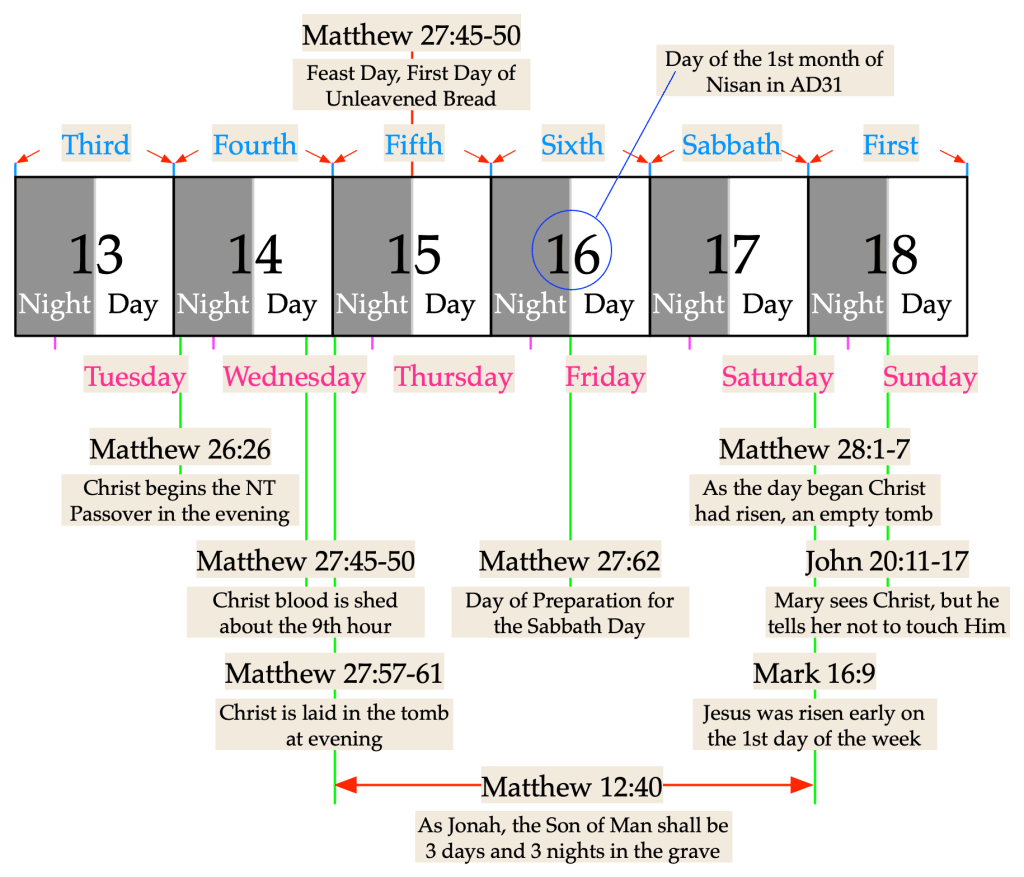
The timeline above shows the days of the 1st month during the Passover and Unleavened Bread season in AD 31 when Christ instituted the New Testament Passover and willingly gave Himself to be crucified, to shed His blood for the covering of sin, and then to be raised up after 3 nights and 3 days in the grave.
This is not what is taught by traditional Christianity, but it is biblical and accurate.
We have already seen the New Testament scriptures that tie in perfectly with the Old Testament about selecting the lamb and and the numbering of days until Christ enacts the New Testament Passover. It was later that night that Christ willingly gave Himself to be crucified; about the same time as when the death angel would have passed over the homes of the Israelites in Egypt who had killed the lamb and placed the blood on the door posts and lintels (Exodus 12:13).
While Christ gave himself to be crucified in the evening of the 14th day of the first month, it was not until about 3pm that day that His blood was shed for all sin. Subsequently Joseph of Arimathaea who was a disciple of Christ petitioned Pilate the governor for Christ’s body, and when he received Christ’s body he laid Christ in the tomb in the evening as the First Day of Unleavened Bread was beginning, the 15th day of the first month (Matthew 27:57-61). Notice that Mary Magdalene and Mary the mother of Christ were watching and knew where Christ’s body had been laid.
Matthew 27V57 When the even was come, there came a rich man of Arimathaea, named Joseph, who also himself was Jesus’ disciple:
V58 He went to Pilate, and begged the body of Jesus. Then Pilate commanded the body to be delivered.
V59 And when Joseph had taken the body, he wrapped it in a clean linen cloth,
V60 And laid it in his own new tomb, which he had hewn out in the rock: and he rolled a great stone to the door of the sepulchre, and departed.
V61 And there was Mary Magdalene, and the other Mary, sitting over against the sepulchre.
In AD31 the First Day of Unleavened Bread began at sunset at the beginning of the 5th day of the week, or Wednesday evening in our calendar. This Holy Day ended the following evening at the beginning of the 6th day of the week, or Thursday evening in our calendar. This Holy Day was a High-Sabbath, nothing could be brought or sold and nothing could be prepared. It was not until the daylight hours of the 6th day that spices for burial could be purchased and prepared. This was the weekly “day of preparation” for the weekly sabbath.
Mark 16V1 And when the sabbath was past, Mary Magdalene, and Mary the mother of James, and Salome, had bought sweet spices, that they might come and anoint him.
The women played a very important role in the crucifixion and resurrection of Christ. They observed everything, even when the disciples were afraid to be near Christ, God had the actions and observations of the women recorded in the scriptures so that the accuracy of the events could be verified. This verse in Mark 16 is critical in confirming that Christ was in the grave, the tomb, exactly three days and three nights. It was the only sign that Christ gave to physically prove that He was the Messiah. “For as Jonas was three days and three nights in the whale’s belly; so shall the Son of man be three days and three nights in the heart of the earth” (Matthew 12V40).
After Mary Magdalene and Mary the mother of James had purchased the spices and prepared them, the next day was the weekly Sabbath, the 7th day or Saturday in our calendar (starting at Friday evening). As was the custom and as instructed by God, the women would have rested and observed the weekly sabbath. This timing is confirmed in the following verses in Matthew 27.
On the first day of the week after the sabbath
Matthew 27V62 Now the next day, that followed the day of the preparation, the chief priests and Pharisees came together unto Pilate,
V63 Saying, Sir, we remember that that deceiver said, while he was yet alive, After three days I will rise again.
V64 Command therefore that the sepulchre be made sure until the third day, lest his disciples come by night, and steal him away, and say unto the people, He is risen from the dead: so the last error shall be worse than the first.
V65 Pilate said unto them, Ye have a watch: go your way, make it as sure as ye can.
V66 So they went, and made the sepulchre sure, sealing the stone, and setting a watch.
It was on the weekly sabbath day that the chief priests and Pharisees petitioned Pilate. It seems they had no qualms about ‘working’ on the sabbath, for they assembled a guard and sealed the tomb immediately (verse 66). The aftermath of this is confirmed in Matthew 28:11-15. They key point is that the tomb was sealed and a guard put in place during the daylight hours of the weekly sabbath day. This was during the third day that Christ was in the tomb.
Matthew 28V1 In the end of the sabbath, as it began to dawn toward the first day of the week, came Mary Magdalene and the other Mary to see the sepulchre.
V2 And, behold, there was a great earthquake: for the angel of the Lord descended from heaven, and came and rolled back the stone from the door, and sat upon it.
V3 His countenance was like lightning, and his raiment white as snow:
V4 And for fear of him the keepers did shake, and became as dead men.
V5 And the angel answered and said unto the women, Fear not ye: for I know that ye seek Jesus, which was crucified.
V6 He is not here: for he is risen, as he said. Come, see the place where the Lord lay.
The resurrection timeline, observed by the women and preserved for our understanding.
Mark 16V1 And when the sabbath was past, Mary Magdalene, and Mary the mother of James, and Salome, had bought sweet spices, that they might come and anoint him.
V2 And very early in the morning the first day of the week, they came unto the sepulchre at the rising of the sun.
V3 And they said among themselves, Who shall roll us away the stone from the door of the sepulchre?
V4 And when they looked, they saw that the stone was rolled away: for it was very great.
V5 And entering into the sepulchre, they saw a young man sitting on the right side, clothed in a long white garment; and they were affrighted.
V6 And he saith unto them, Be not affrighted: Ye seek Jesus of Nazareth, which was crucified: he is risen; he is not here: behold the place where they laid him.
Luke 24V1 Now upon the first day of the week, very early in the morning, they came unto the sepulchre, bringing the spices which they had prepared, and certain others with them.
V2 And they found the stone rolled away from the sepulchre.
V3 And they entered in, and found not the body of the Lord Jesus.
V4 And it came to pass, as they were much perplexed thereabout, behold, two men stood by them in shining garments:
V5 And as they were afraid, and bowed down their faces to the earth, they said unto them, Why seek ye the living among the dead?
V6 He is not here, but is risen: remember how he spake unto you when he was yet in Galilee,
V7 Saying, The Son of man must be delivered into the hands of sinful men, and be crucified, and the third day rise again.
V8 And they remembered his words,
In each of these accounts the women went to the tomb after the weekly sabbath had ended. It was very early on the first day, at the rising of the sun, most likely as the dawn was just breaking, “when it was yet dark” (John 20:1). They found that the stone had been rolled away, that Jesus Christ was not there. He had already risen. The angel of the Lord appeared to the guards that had been placed at the tomb and they were so afraid they became as dead men, petrified.
In each of these accounts it was the women who went and told the disciple that Christ had risen, as they were instructed by the angels, but the Gospel John gives some additional detail.
John 20V1 The first day of the week cometh Mary Magdalene early, when it was yet dark, unto the sepulchre, and seeth the stone taken away from the sepulchre.
V2 Then she runneth, and cometh to Simon Peter, and to the other disciple, whom Jesus loved, and saith unto them, They have taken away the Lord out of the sepulchre, and we know not where they have laid him.
V3 Peter therefore went forth, and that other disciple, and came to the sepulchre.
V4 So they ran both together: and the other disciple did outrun Peter, and came first to the sepulchre.
V5 And he stooping down, and looking in, saw the linen clothes lying; yet went he not in.
V6 Then cometh Simon Peter following him, and went into the sepulchre, and seeth the linen clothes lie,
V7 And the napkin, that was about his head, not lying with the linen clothes, but wrapped together in a place by itself.
V8 Then went in also that other disciple, which came first to the sepulchre, and he saw, and believed.
V9 For as yet they knew not the scripture, that he must rise again from the dead.
V10 Then the disciples went away again unto their own home.
The women went and told the disciples and they came to see for themselves. It appears that the disciples did not see the angels, that only the women saw them, and the scriptures indicate that the disciples did not yet understand that Christ would be resurrected, and perhaps with dejection returned to their homes. However, Mary stayed there.
John 20V11 But Mary stood without at the sepulchre weeping: and as she wept, she stooped down, and looked into the sepulchre,
V12 And seeth two angels in white sitting, the one at the head, and the other at the feet, where the body of Jesus had lain.
V13 And they say unto her, Woman, why weepest thou? She saith unto them, Because they have taken away my Lord, and I know not where they have laid him.
V14 And when she had thus said, she turned herself back, and saw Jesus standing, and knew not that it was Jesus.
V15 Jesus saith unto her, Woman, why weepest thou? whom seekest thou? She, supposing him to be the gardener, saith unto him, Sir, if thou have borne him hence, tell me where thou hast laid him, and I will take him away.
V16 Jesus saith unto her, Mary. She turned herself, and saith unto him, Rabboni; which is to say, Master.
V17 Jesus saith unto her, Touch me not; for I am not yet ascended to my Father: but go to my brethren, and say unto them, I ascend unto my Father, and your Father; and to my God, and your God.
V18 Mary Magdalene came and told the disciples that she had seen the Lord, and that he had spoken these things unto her.
Let’s think for a moment about the timeline. The women first came to the tomb about sunrise, that would have been between 5am and 6am at this time of year. The women would have spent at least a short time there before they went back to tell the disciple. The women then returned to the tomb with the disciples. This would likely to have taken at least an hour, but perhaps two hours. It would now be perhaps 8am in the morning.
When Mary saw whom she perceived to be the gardener, Jesus had already been resurrected for some time, many hours since the beginning of the day (at sunset), but there was something important yet to be done. When Christ opened Mary’s mind, her ears and her eyes, to know it was Him she must have been overcome with emotion. One moment she thought that Christ’s body had been taken away and she wanted to know where it was so she could anoint it with the spices that had been prepared, to seeing Him is the flesh alive and in front of her. She would have gone from despair to adulation. She would have wanted to hug Christ close to herself.
But “Jesus saith unto her, Touch me not; for I am not yet ascended to my Father: but go to my brethren, and say unto them, I ascend unto my Father, and your Father; and to my God, and your God.”
God had to accept Christ’s sacrifice as being perfect, worthy of covering all sin.
Jesus Christ is in 100% submission to God the Father. God the Father set the law; “The soul that sinneth, it shall die” (Ezekiel 18:20). For the shedding of Christ’s blood to be an acceptable sacrifice He must have been without sin.
Ezekiel 18 verse 20 goes on to say; “The son shall not bear the iniquity of the father, neither shall the father bear the iniquity of the son: the righteousness of the righteous shall be upon him, and the wickedness of the wicked shall be upon him.”
God the Father could not take on any sin of His Son Jesus Christ, Christ had to totally take sin on Himself, without Himself sinning. Did He achieve that? It was not up to Christ to decide, it was God who set the law, it was God who needed to judge according to the law. God the Father had to ratify that Christ had in fact lived a sinless life and had given His life, His blood, as payment for all sin. Until that acceptance had taken place, the ratification of the law, then our salvation was not secure.
That is why the risen Christ told Mary not to touch Him, He had to present Himself in His utterly pure state before His Father, God.
Remember, we started this section of the bible Study in Leviticus chapter 23 and verse 9. Let’s read it again
Leviticus 23V9 And the LORD spake unto Moses, saying,
V10 Speak unto the children of Israel, and say unto them, When ye be come into the land which I give unto you, and shall reap the harvest thereof, then ye shall bring a sheaf of the firstfruits of your harvest unto the priest:
V11 And he shall wave the sheaf before the LORD, to be accepted for you: on the morrow after the sabbath the priest shall wave it.
The Apostle Paul reminds us the Christ is the firstfruit, the first of those who die a physical death to be resurrected to eternal life.
1 Corinthians 15V20 But now is Christ risen from the dead, and become the firstfruits of them that slept. (Who have died.)
1 Corinthians 15V23 But every man in his own order: Christ the firstfruit; afterward they that are Christ’s at his coming.
God had Israel perform a ceremony every year during the Days of Unleavened Bread that pictured the firstfruit being waved before God to receive His acceptance. Notice that it says the acceptance is for you. God was accepting the sacrifice of Christ, not for Himself, but for us, for all humanity, for the covering of our sins.
When did this happen? On the morrow after the sabbath the priest shall wave it. The sheaf of the firstfruits of the field representing Christ was waved by the priest about the 3rd hour in the morning, about 9am, the very morning that Christ told Mary not to touch Him as He needed to ascend to the Father.
God is perfect, He has everything planned to the last detail. What God had Israel enact for generations accurately depicted the real thing, Christ’s sacrifice being accepted for our sin. After Christ ascended to the Father He came back and opened the eyes of the disciples so that they would understand. This very act of coming back to work with the disciples proves that Christ’s sacrifice was accepted, that it did fulfil the requirements of the law and that therefore our salvation is sure. We can have no doubt that our sins are covered by the shed blood of Jesus Christ.
Christ’s sacrifice by the shedding of His life blood and His subsequent resurrection had to come first. We cannot be saved, be resurrected to eternal life without Christ the firstfruit coming first. Again God has the detail.
Leviticus 23V14 And ye shall eat neither bread, nor parched corn, nor green ears, until the selfsame day that ye have brought an offering unto your God: it shall be a statute for ever throughout your generations in all your dwellings.
We read up to verse 11 in Leviticus 23, and verses 12 & 13 set out the other sacrifices and offerings that God instructed the priesthood to perform on this day, see the explanation below. But here in verse 14 God makes a very specific instruction to all Israel. They shall not eat anything of the new harvest until after the wave sheaf had been presented before God. It applied to everyone, for ever, a statute forever, it cannot be broken.
There could be no harvest of humanity until after Christ’s sacrifice had been accepted by God. Christ is the first fruit (singular), the first to be resurrected to eternal life. The rest of the harvest in this season is referred to as the firstfruits, plural, depicting the harvest of all whom God calls up until Christ’s return.
But yet again there is more.
Along with the Wave Sheaf depicting Christ’s judgement and acceptance by God, the priest also offered a lamb as a sin offering, marking the ongoing covering for sin made possible by Christ’s life blood being poured out. There is also a food offering.
Leviticus 23V12 And ye shall offer that day when ye wave the sheaf an he lamb without blemish of the first year for a burnt offering unto the LORD.
V13 And the meat offering thereof shall be two tenth deals of fine flour mingled with oil, an offering made by fire unto the LORD for a sweet savour: and the drink offering thereof shall be of wine, the fourth part of an hin.
The fine flour mingled with oil are the ingredients for unleavened bread. That, coupled with the drink offering of wine, suggests that this offering represents the body and blood of Christ, the elements of the new Testament Passover. How fantastic it is to see God weaving the old and new into a precise plan of salvation. The New Testament Passover is not really new at all, it has always been there, picturing Christ.
Leviticus 23V15 And ye shall count unto you from the morrow after the sabbath, from the day that ye brought the sheaf of the wave offering; seven sabbaths shall be complete:
V16 Even unto the morrow after the seventh sabbath shall ye number fifty days; and ye shall offer a new meat offering unto the LORD.
V17 Ye shall bring out of your habitations two wave loaves of two tenth deals: they shall be of fine flour; they shall be baken with leaven; they are the firstfruits unto the LORD.
The importance of “the morrow after the sabbath” is again stressed, the point from which a count of weeks is made until the next holy day. A day where the food offering is prominent, but this time two leavened loaves.
This is a the subject of another bible study and a key to our salvation.
But one last observation
In all four gospels the same phraseology is used to describe the women heading to the tomb where Christ had been laid.
Matthew 28V1 In the end of the sabbath, as it began to dawn toward the first day of the week, came Mary Magdalene and the other Mary to see the sepulchre.
Mark 16V2 And very early in the morning the first day of the week, they came unto the sepulchre at the rising of the sun.
Luke 24V1 Now upon the first day of the week, very early in the morning, they came unto the sepulchre, bringing the spices which they had prepared, and certain others with them.
John 20V1 The first day of the week cometh Mary Magdalene early, when it was yet dark, unto the sepulchre, and seeth the stone taken away from the sepulchre.
In each of these verses the word day is in italics in the King James version denoting that this word is not in the original text. If we take the word day out we get “first of the week”. The word for week in Greek is derived from the Hebrew for sabbath, sabbaton, meaning from sabbath to sabbath – a week. Further, in Greek the word is in the plural form σαββάτων, therefore it is likely that the phrase “first of the week” should have been translated “first of the weeks” or from sabbaths to sabbaths. Afterall, this special day, the day of the wave sheaf depicting the acceptance of Christ’s sacrifice by God, marks the beginning of the counting of weeks, it was the “first of the weeks” of counting.
Note also the same Greek word is also translated sabbath in Matthew 28V1. Perhaps here also this word should have been translated sabbaths, plural, meaning after the end of the two sabbaths, the first day of unleavened bread and the weekly sabbath. This ties in perfectly with the timeline of events.
How Great is our God, His plan is perfect. He is the author and the finisher of our salvation.
Download Passover and the First Holy Day Season
 God is not random, He has a plan that He is working to.